| Journal title | Journal of AI Failure and Risk Analysis | 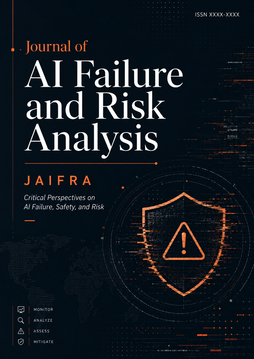 |
|
| Abbreviation | J. AI Fail. Risk Anal. | ||
| E-ISSN | XXXX-XXXX | ||
| Editor-in-chief | Editor-in-Chief Name (Institution, Country) | ||
| Publisher | Prestige Publisher | ||
| Organized / Collaboration | Research and Academic Collaboration Partners; Artificial Intelligence Safety, Reliability, Risk, and Governance Research Community. | ||
| Publication Frequency | Biannual / Quarterly | ||
| Language | English | ||
| Article Processing Charge | To be announced |
Journal of AI Failure and Risk Analysis is an international peer-reviewed open-access journal dedicated to publishing high-quality research on artificial intelligence failures, risk identification, system reliability, safety, accountability, and mitigation strategies. The journal provides an academic platform for scholars, practitioners, policymakers, engineers, and technology developers to examine how AI systems fail, why such failures occur, and how risks can be assessed, governed, and reduced in real-world applications.
The journal welcomes original research articles, systematic literature reviews, conceptual papers, case studies, technical reports, methodological contributions, and critical analyses related to AI failure and risk analysis. The scope includes AI system failure, model degradation, data bias, algorithmic error, hallucination in generative AI, adversarial vulnerability, cybersecurity risks, explainability gaps, human-AI interaction failures, operational risk, AI safety, risk-based governance, and responsible deployment of artificial intelligence systems.
JAIFRA encourages interdisciplinary contributions from computer science, data science, information systems, cybersecurity, engineering, public policy, law, ethics, management, healthcare, education, finance, and other applied domains. The journal particularly emphasizes studies that connect technical AI performance with risk management, failure prevention, transparency, robustness, resilience, accountability, compliance, and the practical implementation of safety-oriented AI frameworks.
As part of its commitment to academic quality, submitted manuscripts must present clear research problems, rigorous methods, relevant literature, strong analytical discussion, and meaningful contributions to the advancement of artificial intelligence reliability and risk analysis. All submissions are initially screened by the editorial team and subsequently reviewed by qualified reviewers according to the journal's peer-review policy.
Important Dates :
Paper Submission Date: Any time
Online Publication Date:
Articles are published according to the journal issue schedule after completing the review, revision, acceptance, copyediting, and production stages.
Publication Schedule
Starting from the first publication year, JAIFRA publishes issues in accordance with the official publication frequency determined by the editorial board.
Before submission,
Authors must ensure that their manuscript has been prepared using the JAIFRA paper template, has been carefully proofread, and follows the author guidelines. Manuscripts must be written in English and should not be under consideration by another journal or publication venue.
Online Submissions
- Already have a username/password for JAIG: Journal of Artificial Intelligence Governance? GO TO LOGIN
- Need a username/password? GO TO REGISTRATION
Registration and login are required to submit items online and to check the status of current submissions.
Focus and Scope
- Artificial intelligence failure analysis, system breakdown, model degradation, and error diagnosis.
- AI safety, reliability, robustness, resilience, and trustworthy system design.
- Risk identification, risk assessment, risk mitigation, and risk-based AI governance.
- Algorithmic bias, data quality problems, hallucination, adversarial attacks, and cybersecurity risks in AI systems.
- Explainability, transparency, auditability, accountability, compliance, and responsible AI deployment.
- Human-AI interaction failures, automation risk, decision-support errors, and socio-technical consequences of AI misuse.
- AI risk management in public administration, enterprise systems, healthcare, education, finance, cybersecurity, and other applied sectors.
Current Issue
Vol. 1 No. 1 (2026): Regular Issue: May 2026
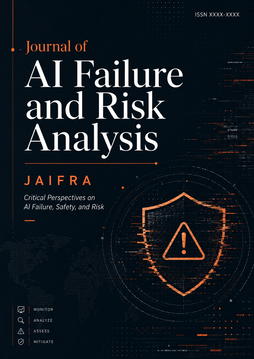
This issue available online during May 2026 for the regular issue of May 2026. All articles in this issue (5 original research articles) were authored/co-authored by 15 authors from 2 countries (Malaysia, and Indonesia).


Published: 2026-06-30